


The Complete Landlord Compliance Calendar: What Checks Are Due and When?


If you self-manage your rental property, compliance can feel like spinning plates. Gas safety here, an electrical report there, a deposit deadline, an EPC you're sure is somewhere in your inbox.
Most landlord compliance problems aren't caused by ignoring the rules. They come from losing track of dates. A gas certificate quietly expires. A tenant reports a repair and it slips down the to-do list. A deposit deadline passes during a busy week.
This guide gives you two things: a clear overview of what's due and when, and a month-by-month calendar you can work through all year.
The landlord compliance overview
Requirement | How often? | Who is responsible? | Evidence to keep |
Gas Safety | Every 12 months | Landlord | CP12 |
EICR | Normally every 5 years | Landlord | EICR |
Smoke/CO alarms | Check at relevant points | Landlord | Test/inspection records |
EPC | Check validity / renewal requirements | Landlord | EPC |
Legionella risk assessment | Risk-based | Landlord | Assessment |
Fire risk assessment | Risk-based / where applicable | Landlord | FRA |
HMO licence | Licence-specific | Landlord | Licence |
Property inspections | Best-practice/risk-based | Landlord | Inspection report |
Deposit protection | Within required statutory timescale | Landlord/agent | Scheme certificate/prescribed information |
Repairs | As required | Landlord | Repair records |
Even if a letting agent handles the day-to-day, the legal responsibility usually stays with you. Agents can carry out tasks on your behalf, but they can't take on your duties. It's worth knowing what they are actually doing for you.
The checks in plain English
Gas safety. Any property with a gas appliance needs a gas safety check by a Gas Safe registered engineer every 12 months. Tenants need a copy of the certificate (the CP12) within 28 days of the check, and new tenants must receive one before they move in. Keep every certificate, because you may need to show a history, not just the latest one.
EICR (electrical safety). Fixed electrical installations must be inspected and tested at least every 5 years, or sooner if the report says so. Tenants must get a copy within 28 days, and your local council can ask for one. If the report finds urgent issues, you have a short window to fix them, so don't leave the paperwork in a drawer.
Smoke and carbon monoxide alarms. You need a working smoke alarm on every storey used as living accommodation, and a carbon monoxide alarm in any room with a fixed combustion appliance (excluding gas cookers). They must be tested on the first day of each new tenancy. It's good practice to also check them at every inspection and keep a record.
EPC. You need a valid EPC to let a property, and it currently needs to be rated at least E. EPCs last 10 years, so the "due date" is easy to forget. Looking ahead, the government confirmed in January 2026 that the minimum will rise to EPC C from 1 October 2030. Checking your rating now gives you time to plan improvements rather than rush them. epclookup
Legionella risk assessment. Landlords must assess and control the risk of legionella in the water system. For most ordinary rental homes the risk is low and the assessment is simple, but it's still your responsibility, and it should be recorded and reviewed when something changes, such as a long void period or new plumbing.
Fire risk assessment. Required for shared or communal areas, such as blocks of flats and many HMOs. Even where it isn't strictly required, thinking through escape routes and fire safety is sensible. Keep the assessment and act on its findings.
HMO licence. If your property is licensed, the licence has its own start and end dates and its own conditions. Diarise the renewal well ahead, because councils can take time to process applications.
Property inspections. There's no single fixed legal frequency, but regular inspections (many landlords choose every 3 to 6 months) help you catch repairs early and evidence that you manage the property properly. Give tenants proper notice and keep a written report with dated photos.
Deposit protection. A tenancy deposit must be protected in a government-approved scheme, and the prescribed information given to the tenant, within 30 days of receiving it. Keep the scheme certificate and proof you served the information.
Repairs. There isn't a calendar date, but there is a duty. Log every report, when you responded, who fixed it and when it was completed. This record is often the deciding factor in a dispute.
Don't forget: the Renters' Rights Act
England's tenancy rules changed significantly this year. The Renters' Rights Act 2025 took full effect on 1 May 2026, and landlords had to send tenants the government information sheet by 31 May 2026. Looking ahead, registrations for the new PRS landlord database open on 15 December 2026, so it's worth putting that date in your calendar now. Landlord registration will be part of your compliance routine going forward. Renters' Rights Act 2025: What Every UK Landlord Needs to Know +2
Your annual landlord compliance calendar
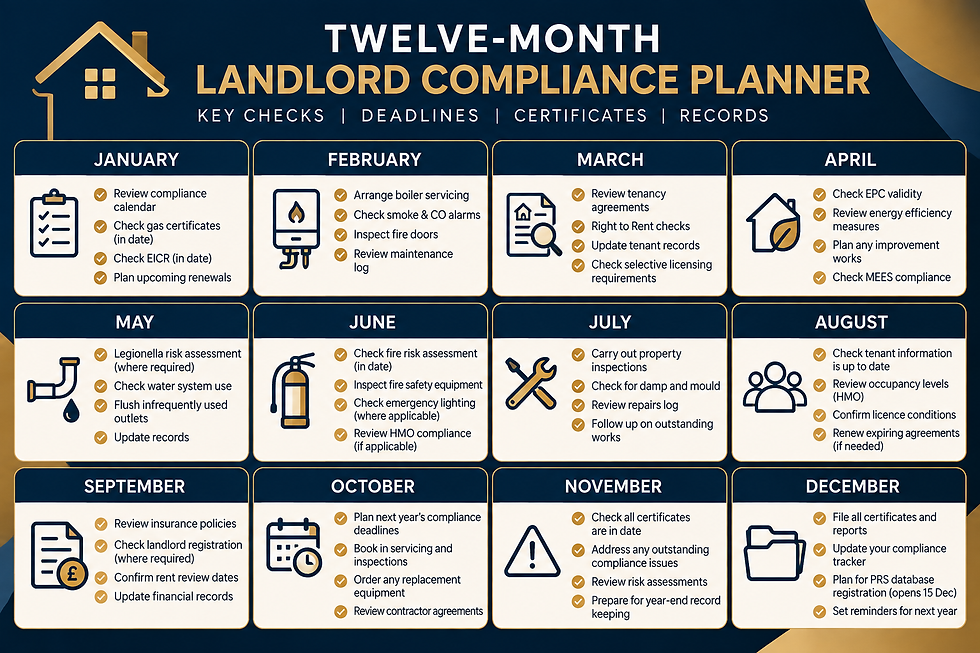
Treat this as a framework. Your own certificate dates will differ, so swap in your real expiry dates and let the calendar prompt you.
January: Get organised
Review all compliance records for every property
Check certificates expiring in the next 3 months
Review outstanding repairs
February: Inspect and update
Carry out property inspections
Review tenant information (contact details, occupants, emergency contacts)
Check smoke and CO alarms during visits
March: Safety certificate check
Book gas safety checks due in the next 60 days
Confirm EICR dates and arrange any remedial work
Check EPC validity and ratings
April: Financial and admin housekeeping
Review rent levels and any planned rent increases (using the correct formal process)
Review landlord insurance and check the cover matches the property
Check tenancy paperwork is up to date
May: Mid-year compliance review
Check that tenants have all required documents
Review HMO licence conditions and renewal dates
Update your compliance tracker
June: Summer maintenance
Inspect exteriors, roofs, gutters and gardens
Review legionella risk, especially for any empty periods
Follow up on outstanding repairs
July: Property inspections
Carry out your second round of inspections
Test alarms again where appropriate
Record findings and photos
August: Look ahead
Check certificates expiring before the end of the year
Book contractors early, because autumn is busy
Review EPC ratings and plan any energy improvements
September: Prepare for winter
Arrange boiler servicing and heating checks
Check for damp, mould and ventilation issues
Review fire safety and emergency information
October: Heating season
Respond quickly to heating and hot water reports
Carry out inspections and check for early signs of damp
Review repair logs and response times
November: Year-end review
Audit all certificates and records for each property
Confirm anything expiring in January to March is booked
Check deposit records are complete
December: Reset
Add next year's deadlines to your calendar or tracker
Make sure you're ready for the PRS database registration (opens 15 December)
Archive the year's records neatly
Keep the evidence, not just the certificate
Doing the check is only half the job. If a tenant, agent, council or insurer ever asks, you need to be able to prove what was done and when. For every requirement, keep the certificate or report, proof you gave it to the tenant, dated inspection notes and photos, and a repair log with dates.
A simple, consistent system beats a perfect one you don't use.
Download the Circle Doors Landlord Compliance Checklist
Want all of this in one place? The Circle Doors Landlord Compliance Checklist brings every requirement, deadline and evidence type into a single printable tracker, so you can see at a glance what's due and what's coming up.
This article is general guidance for landlords in England and isn't legal advice. Rules and deadlines can change, and requirements vary by property type and local authority, so always check current government guidance or take professional advice for your situation.



Comments